









Open Standard Modules (OSM) represent a new, future-proof and versatile standard for small, low-cost embedded computer modules. Key benefits include:
– fully automated processing for soldering, assembly and testing
– pre-tinned LGA (Land Grid Array) packages for direct PCB (Printed Circuit Board) soldering without connectors
– predefined hardware interfaces
– robustness against shock and vibration
Defined by SGeT (Standardization Group for Embedded Technologies), the goal of OSM is straightforward – to combine the advantages of modular embedded computing with the increasing demands on cost, space and interfaces across a growing number of IoT applications.
Learn how OSM supports cost-effective embedded system design for volume production. Complete the form to download the whitepaper.
| Size | Name | Dimensions | Contacts |
|---|---|---|---|
| Size 0 | Zero | 30 × 15 mm | 188 |
| Size S | Small | 30 × 30 mm | 332 |
| Size M | Medium | 45 × 30 mm | 476 |
| Size L | Large | 45 × 45 mm | 662 |
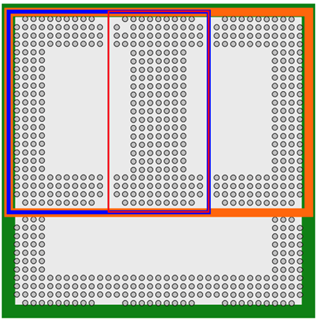
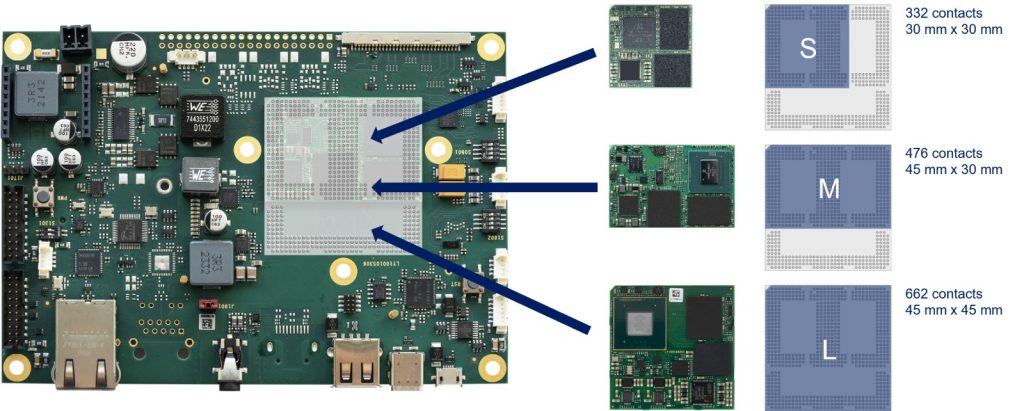
The OSM standard features a continuous, compatible pinout across all module sizes – each larger size features the pins of the smaller sizes in the same positions and adds more. That means the same carrier board design can be used for different OSM module sizes.
Example: TRIA-MB-EP5 carrier board accepts Size S (30 × 30 mm / 332 contacts), Size M (45 × 30 mm / 476 contacts), and Size L (45 × 45 mm / 662 contacts)
The right module for your application
Tria’s OSM family spans a full performance range across three predefined sizes. For customers seeking assistance in selection and/or integration, our experts are on hand to help. Just ask.
Getting started with OSM is straightforward. Tria provides evaluation boards and starter kits for every module in the portfolio, so you can evaluate, prototype, and design-in with confidence. A Yocto-based Linux Board Support Package is included, with additional OS support on request.
Tria OSM‑SB‑EP5
Our flagship evaluation board, supports S/M/L, SimpleFlex form factor, ready out of the box. Learn more.
MaaXBoard OSM93
Raspberry Pi-sized SBC, i.MX 93, dual GbE, ideal for quick prototyping. Learn more.
The OSM standard is developed and managed by SGeT (Standardization Group for Embedded Technologies), of which Tria is a founding member. To learn more about the standard or download the specification, visit the SGeT website.
When selecting a solderable module, the choice is either the proprietary route, or standardized. Here’s why standardized is the clear winner:
| Proprietary Modules | Standardized (OSM) |
|---|---|
| Tailored to a single SoC | Defined by an independent standards body (SGeT) |
| Supports only one vendor | Scalable across CPU vendors and performance tiers |
| No footprint-compatible upgrade or successor | Second-source available from multiple suppliers |
| May access full SoC feature set | In some cases, minor limitations on usable SoC features |
| Slightly smaller footprint possible | Specified size, pinout, electrical and mechanical features |
Tria’s focus is open standards – providing customers with freedom and flexibility.
Tell us about your project and we’ll help you select and integrate the right OSM solution.
Let us know about your product or your challenge and our team will get in touch to discuss how we can help.
Let's TalkYour privacy is important to us.
We use cookies to enhance your experience when visiting our websites: performance cookies show us how you use this website, functional cookies remember your preferences and targeting cookies help us to share content relevant to you. Select "Accept all" for giving your consent to all cookies, select "Cookie settings" for managing the different cookies or select "Reject all" for using only strictly necessary cookies. You can change your cookie settings at any time by clicking on the cookie settings link on the website.