
What do you need from an embedded OS?
When you’re designing an embedded compute product, the OS has to work with your hardware, your application, and your product’s expected life in the field. Before comparing platforms, it’s worth stepping back and asking what you actually need the OS to do.
Below we’ll explore six requirements worth evaluating early – and how the main OS options measure up.
Real-time response and predictable performance
If your application needs guaranteed response times, common in industrial control, motor drives and safety-critical systems, the OS must support precise scheduling and fast interrupt handling. Yocto-based Linux is widely used for this purpose, delivering soft real-time performance suitable for many industrial applications. Windows IoT Enterprise and Ubuntu can handle near-real-time workloads, but neither is designed for hard timing guarantees. Android’s UI-focused architecture adds latency that makes it less suited to time-critical tasks.System footprint and efficiency
Embedded hardware often has limited RAM, storage and power budget. A smaller OS footprint means lower BOM costs and longer battery life. Yocto lets you strip the image down to exactly what your product needs, reducing hardware cost and power consumption. Ubuntu Pro and Windows IoT Enterprise both carry a larger base footprint, and Windows offers limited scope to strip back the core OS. Android carries a heavier base footprint than the other three.Hardware integration and driver support
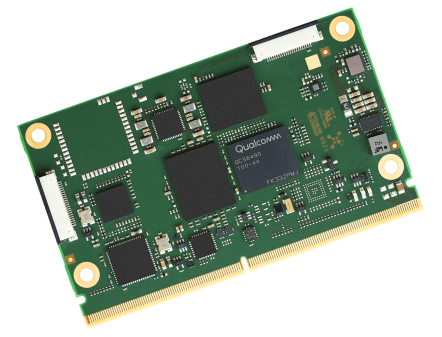
The OS needs to work with your chosen processor, peripherals and interfaces (I2C, SPI, UART, Ethernet, Wi-Fi). That means reliable BSP support, drivers, and a hardware abstraction layer. Yocto’s layered architecture makes it straightforward to build and maintain custom BSPs for any hardware. Ubuntu Pro works well out of the box on Canonical-certified hardware. Windows IoT Enterprise has broad driver support within x86, and now supports ARM via Qualcomm, including Tria’s own Qualcomm-based compute modules. Android requires vendor-specific BSP work, typically tied to Qualcomm or similar SoC platforms.Security and compliance
Connected devices need secure boot, encrypted communications, kernel hardening, and a clear path for ongoing vulnerability patching. The EU Cyber Resilience Act (CRA) makes this a regulatory requirement from 2027, including a mandatory software bill of materials. Yocto offers full control over security configuration and produces reproducible builds with complete component manifests, making CRA compliance straightforward. Ubuntu Pro includes ten years of CVE patching from Canonical. Windows IoT Enterprise LTSC comes with a defined Microsoft support contract. Android benefits from AOSP security features, but long-term embedded security depends on Google, Qualcomm and AOSP continuing to align, and that isn’t guaranteed.Connectivity and software ecosystem
Most embedded products now need networking (Wi-Fi, Bluetooth, TCP/IP), cloud integration, and access to standard libraries and file systems. Some also need a GUI framework. All four platforms offer robust networking stacks. Android and Ubuntu have the richest software ecosystem out of the box. Yocto requires you to select and configure components explicitly; that’s more work upfront, but a leaner result. Windows IoT Enterprise integrates natively with Azure and Microsoft cloud services.Long-term support and lifecycle
Embedded products often live for 10 to 20 years. The OS needs to support over-the-air updates, long-term security patching, and mature development tools. Yocto appeals to many OEMs because it offers complete lifecycle control. You maintain the stack on your own timeline, with no dependency on any vendor’s decision to continue or end support. Ubuntu Pro provides up to ten years of managed support from Canonical, though it is a costly option at scale. Windows IoT Enterprise LTSC offers ten-year support per release, but you remain tied to Microsoft’s lifecycle decisions. Android is already proving its value in specific industrial segments, from rugged tablets to field service devices in demanding environments. However, its mobile-market origins and shorter refresh cycles mean long lifecycle support requires more careful planning than the other three options.The right OS depends on your unique product.
Every embedded project balances these needs differently. The OS that best fits your technical requirements and business priorities will be the right one. But that’s rarely obvious without working through the trade-offs in detail.How Tria can help
Our in-house embedded software team works with OEMs from BIOS to OS to application layer, developing board support packages, custom operating systems, firmware and applications.
We offer a wide range of off-the-shelf and customizable compute modules, each matched to the right OS for its hardware, with BSPs available for hundreds of board configurations and rapid prototyping tools.
For dedicated software development services, Witekio, an Avnet company, also offers full-stack, edge-to-cloud development.