
Which OS is best for embedded computing?
There is no single OS that suits every embedded product. The right choice balances a variety of considerations such as the hardware involved, application demands, team expertise, and product longevity.
Below we summarize four options that we work with every day, with pros and cons for each.
Yocto
Yocto is the industry standard for embedded Linux. It’s a build framework that lets you create a custom Linux distribution tailored to your specific hardware and application. You choose exactly what goes in, and nothing else. That makes it the most efficient option for hardware cost, power consumption, and long-term control.Pros
- Fully customizable, from kernel to application layer
- Free and open source, with no per-unit licensing fees
- Complete vendor independence; you own the stack
- Strong community with broad industrial adoption
- Reproducible builds that support CRA compliance
Cons
- Steep learning curve
- Requires dedicated internal resources for lower-level development
- No turnkey UI; any interface must be built on top
Windows IoT Enterprise
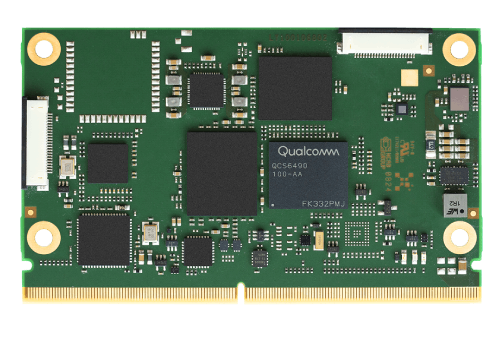
Windows brings a familiar environment, a broad software ecosystem, and strong enterprise integration. For products that need to run Windows-based applications or connect into existing Microsoft infrastructure, it remains a proven choice. Tria offers Windows on ARM via Qualcomm-based compute modules, bringing Windows to lower-power, lower-cost hardware for the first time.Pros
- Familiar development environment with mature tooling
- Strong ecosystem and enterprise integration
- Works well for UI-driven devices such as kiosks, POS terminals and industrial consoles
- LTSC releases offer ten-year support per version
Cons
- Per-device licensing cost
- Limited customization; the core OS is fixed
- Heavier system footprint
- Tied to Microsoft’s lifecycle decisions
Android
Android brings a proven UI framework, a deep app ecosystem, and the kind of user experience that people already know from smartphones. For embedded products where the interface is the product, such as HMI panels, infotainment systems, rugged tablets and digital signage, Android can accelerate development significantly.Pros
- Strong UI framework and familiar user experience
- Rich app ecosystem, ideal for user-facing applications
- Faster development for HMI, tablet and infotainment use cases
- Tria has a proven track record supporting Android on embedded hardware
Cons
- Less low-level control than Yocto
- Dependency on Google, Qualcomm and the AOSP ecosystem
- Not built for long product lifecycles; mobile-market refresh cycles are short
- No CRA-compliant long-term support strategy yet
Ubuntu Pro
Ubuntu Pro offers a standardized, ready-to-run Linux with up to ten years of security maintenance from Canonical. For teams who want a supported, off-the-shelf Linux without building from scratch, it provides a fast path to a working prototype.Pros
- Works out of the box on Canonical-certified hardware
- Up to ten years of CVE patching and managed support
- Fast development and prototyping
- Access to a broad ecosystem of libraries and tools
Cons
- Per-device subscription cost; a more expensive option at scale
- Vendor lock-in to Canonical’s certified ecosystem
- Limited low-level customization compared to Yocto
Deciding which OS fits your project?
Tria can help. Our in-house embedded software team works with OEMs from BIOS to application layer, developing board support packages, custom operating systems, firmware and applications.
We also offer a wide range of off-the-shelf and customizable compute modules, each matched to the right OS for its hardware, with BSPs available for over 600 board configurations, and rapid prototyping tools. All designed to accelerate your product’s journey from design to delivery.
For dedicated software development services, Witekio, an Avnet company, offers full-stack, edge-to-cloud development to help design, build and run world-class software.