
Shaping the future of embedded
An outlook of what’s driving innovation in the embedded market in 2025 by Thomas Staudinger, President of Tria Technologies.
The next 12 months will be interesting for the embedded industrial market as we see a rise in demand for performance, both in raw processing and in machine learning and artificial intelligence (AI). At the same time the European Cybersecurity Act comes into force, so there is expected to be much more of focus on the security, particularly across the Internet of Things (IoT).
To meet these demands, designers are looking for more capabilities from chips and boards, whether that’s from the latest microprocessor, or one with an AI accelerator, or additional wireless connectivity. These innovations, however, need to be delivered without a change of footprint to allow rapid product iteration.
The Need for Flexibility
One of the key lessons from the last couple of years is platform consolidation, and this will continue to grow in 2025. The supply chain disruption during and after the Covid-19 pandemic showed companies that they had too many platforms. So, OEMs are looking to be more flexible in terms of technology and less dependent on one particular platform while simplifying their own supply chain, from design through to product lifecycle.
There is also much stronger demand for more performance. Designers are moving from microcontrollers to microprocessors with enhanced functionality and access to more memory but need all of this to fit into a small footprint.
There is increasing pressure on designers in 2025 to look at the make versus buy decision. Across the hardware design community, a lot of engineers will retire in the next few years. At the same time, the microprocessors that are in use now and coming out from the various companies are getting more and more complex.

This means designing at a chip level is becoming more challenging, so engineering teams are looking at their options. Buying in the technology in the form of a module can save considerable resources and improve the time to market. It also allows companies to differentiate via software because hardware is more or less a commodity.
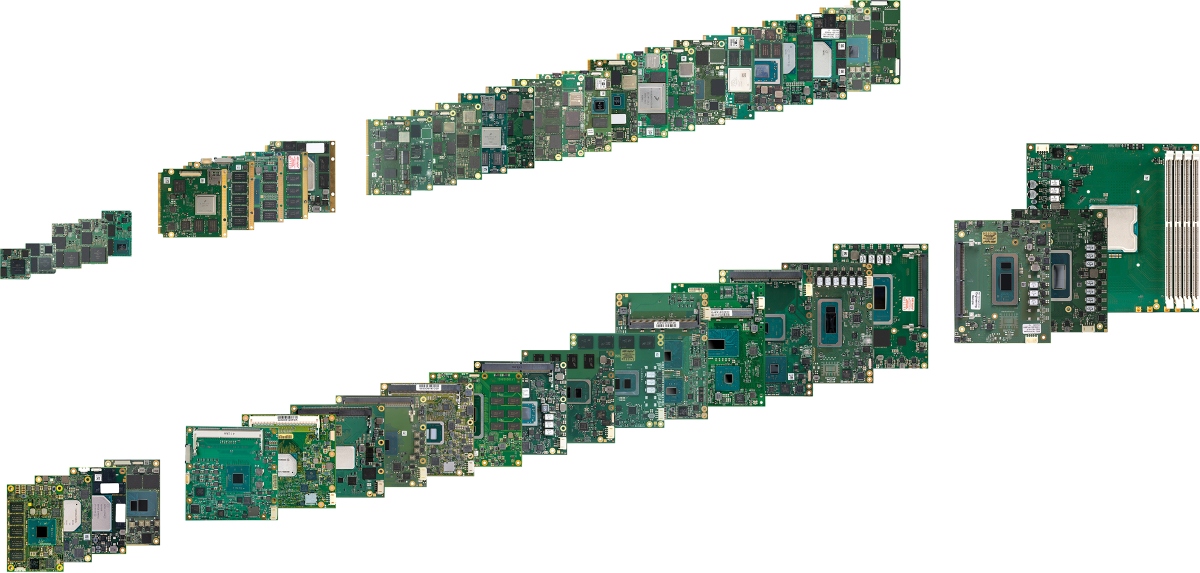
Engineers are increasingly turning to compute modules to provide flexibility, increase speed to market and meet the increasing demands of their application. Modules reduce the challenges associated with supporting multiple processors, making device selection less challenging as it can be upgraded to the latest performance quickly and easily, or a similar part sourced quickly and easily. New standards – such as the Open Standard Module (OSM) – provide a common set of footprints for developers that is not much larger than the processor itself.
OSM will be a critical change as it allows development of reliable modules that are similar to ball grid array packages with a common footprint and pinout definitions, leaving the module makers to innovate on what they can fit into the space. The best modules can then easily be selected and integrated into any application.
Software development timescales can also be reduced by using OSM modules, as modules can be used to begin development before hardware has been developed and prototyped.
However, the testing strategy is different because a standard product would use a single test or a few multiples of a test. Moving to OSM means having a range of processors on the range of modules, and this can increase the testing required for a particular product.
The solderable OSM, which is typically supplied on tape, allows more automated production, avoiding the need for a carrier board and speeding up project delivery times, but this introduces new considerations around test.
The Impact of AI
Artificial intelligence (AI) is a strong trend in the data centre and is beginning to make its way as much into the industrial market. There are a few applications where AI makes a lot of sense, such as predictive maintenance and video, but in general a lot of people have not developed their AI strategy to the point where they have a concrete business case behind it. That’s a bit like the IoT discussion 15 years ago.
Designers, however, need to explore this space and evaluate the different processors and accelerators, and modules are an easy way to add this capability to a design. This is driving interest in demonstrator kits for different applications, particularly video and computer vision applications.
The Need for More Communications Capabilities
Another strong trend is wireless. The emergence of 5G and a lot of the other wireless standards means much more bandwidth is now available, even in applications where people were a bit hesitant in the past, such as industrial automation, so wireless will get more prominent.
It’s interesting that companies such as Qualcomm are entering the industrial market and they have a sweet spot in performance between the x86 and the existing ARM portfolio. Customers are excited about this, having a range of processors and wireless connectivity for different applications.
An Increasing Focus on Security
Security has always been a key consideration for embedded systems development. The European Cybersecurity Resilience Act came into force in December 2024, however, and that will have a huge impact. Module makers will need to make sure that they comply with the regulations through 2025 for their customers.
Developing Modules that Meet the Challenges
The increasing performance and complexity of processors that are being used in today’s embedded systems, and the compact size of OSM modules, means that developing modules presents many challenges. Suppliers with strong track records bring the experience that enable them to deliver a broad portfolio of reliable modules.
It’s not just about providing great hardware: software and security support is key: you can’t just ship a module and forget about it. That support requirement will be considerably more important throughout 2025. Tria has a task force that looks at the regulations and makes sure that we create products along the lines of the legislation. We also have a strong software team that helps customers during the design process, with the software integration and across the project to make sure the design is compliant.
Tria started module development and production many years ago with strong R&D and manufacturing in Germany. Now we’ve added teams in the Americas, Italy, and China, to create a global design network. We’ll also be adding additional R&D capabilities in 2025.
2025 will see considerable changes for the embedded market, but this is just the beginning. As the industrial market returns to growth there will be more and more innovation in the coming years. Smart development teams will partner with strong and experienced module suppliers such as Tria to enable them to meet the diverse challenges they face.