DDR5 Memory for Embedded Systems: Benefits, Use Cases and Modules
With Edge AI and real-time processing pushing memory harder than ever, chances are you’re already thinking about DDR5. We break down what it actually gives you, where it fits in practice, and share some top module recommendations to get you on your way.
What DDR5 Brings to the Table
DDR5 isn’t just DDR4 with a higher clock speed. The architecture has changed in ways that will significantly improve your embedded design.
Twice the bandwidth — DDR5 delivers data rates up to 6,400 MT/s — roughly double what DDR4 could manage. For memory-hungry workloads like AI inference and multi-sensor fusion, that’s the difference between real-time, and not.
Lower power — DDR5 runs at 1.1V versus 1.2V for DDR4, and the LPDDR5 variant drops further to 1.05V core with 0.5V I/O. It also supports Dynamic Voltage and Frequency Scaling, so the memory subsystem scales its power draw to match the actual workload. If you’re building fanless enclosures, battery-powered field devices, or anything thermally constrained, that means less heat to manage, and longer battery life.
Error correction built in — DDR5 includes on-die ECC as standard. You benefit from hardware-level data integrity without bolting on external ECC controllers. A single bit-flip in the wrong place can mean a failed safety check or a misread sensor value. DDR5 handles this at the memory level.
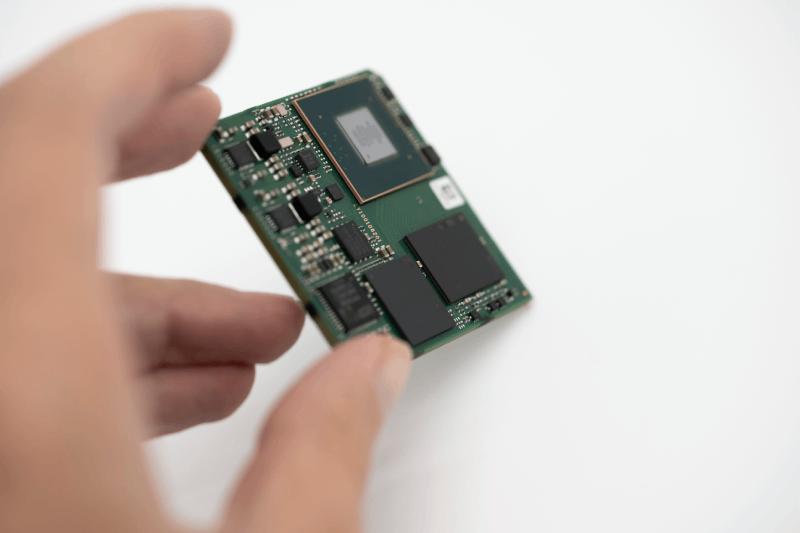
More memory in less space — Multi-die packaging in DDR5 supports up to 64 GB in compact, soldered form factors. You can fit larger AI models, richer datasets and more concurrent workloads onto the same size board. In embedded, where PCB space is always tight, that density is vital.
Better channel efficiency — DDR5 splits each module into two independent 32-bit channels instead of DDR4’s single 64-bit channel. This means better throughput for multi-threaded workloads and lower effective latency. Your system is going to spend less time waiting for memory.
Where Are Engineers Using DDR5?
DDR5 is working hard across some of the most demanding embedded applications out there. Including, but not limited to:
Edge AI — Quality inspection on the factory floor, patient monitoring in hospitals or real-time video analytics in retail. All these run neural networks locally and need sustained memory bandwidth to keep the NPU fed. DDR5 makes it practical to run larger, more accurate models on compact embedded hardware.
Robotics and autonomous systems — Autonomous mobile robots fuse multiple sensor streams simultaneously. DDR5’s dual-channel architecture and higher bandwidth keep up with these parallel data flows, avoiding bottlenecks.
Medical imaging — High-resolution imaging needs both the throughput to handle large datasets quickly and the ECC reliability to ensure diagnostic accuracy. DDR5 delivers on both counts.
Digital signage and HMI — Modern point-of-sale, kiosk, and signage systems run AI-driven content, multi-display output, and real-time analytics at the edge. DDR5 gives them the bandwidth and efficiency to do this without server-class hardware or complex cooling.
DDR5 Across the Tria Module Range
Our world-class engineers have built in DDR5 support across several Tria compute modules, spanning four form factors and three processor architectures, so you can choose the right combination of performance, size, and I/O for your application.
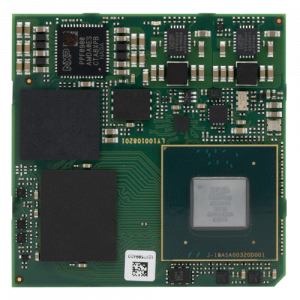
The TRIA OSM-LF-IMX95 puts LPDDR5 with inline ECC on the NXP i.MX 95 in a 45 x 45 mm solder-down OSM module. It includes NXP’s eIQ Neutron NPU, dual Ethernet, and PCIe Gen 3. Ideal for edge AI and industrial IoT where power and board space are at a premium.
The TRIA C6C-IQX and TRIA HMM-IQX step up to 64 GB of LPDDR5X on the Qualcomm Dragonwing IQ-X, with twelve Oryon CPU cores and a 45 TOPS NPU. These are for robotics, autonomous vehicles, and medical systems where you need serious AI horsepower and graphics throughput.
The TRIA Q7-ASL and TRIA Q7-ALN bring LPDDR5 with optional IBECC to Intel platforms on the Qseven form factor — up to 16 GB, triple 4K display output, extended temperature range, and 24/7 operation. Purpose-built for point-of-sale, signage, and ruggedised HMI.
In Short
If you’re designing the next generation of edge, industrial, or autonomous systems, DDR5 is the memory foundation to build on.
Looking to design with DDR5? We support innovators like you, from design to delivery.
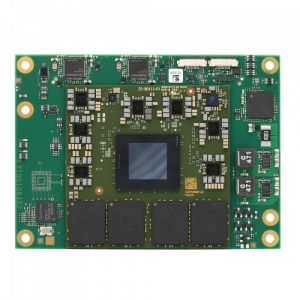
TRIA HMM-IQX
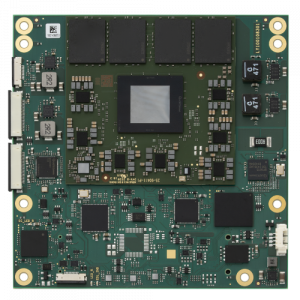
TRIA C6C-IQX
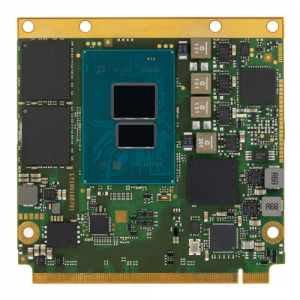
TRIA Q7-ASL
TRIA Q7-ALN