
How Edge AI is Revolutionizing Agriculture: Crops v Cattle
Imagine a drone sweeping low over a field of corn, its camera singling out weeds for microdoses of herbicide in real time. A herd of dairy cows being monitored around the clock for early signs of disease. Or a GPS-enabled virtual fence preventing that same herd from wandering across boundaries. These are just a few of the ways Edge AI is revolutionizing agriculture.
It’s a shift that’s vital. Farmers are already under pressure to produce more from less, squeezed by rising input costs and tightening margins. And that pressure only grows over time: the world’s population is on course to reach nearly 10 billion by 2050, and the Food and Agriculture Organization (FAO) estimates food production will need to rise by around 70% to meet demand.
Being able to process data locally, rather than rely on the cloud, is at the heart of smart agriculture (or Agriculture 4.0). Let’s explore what’s happening across crops and cattle, and what it means for your embedded compute design.
Improving crop yield
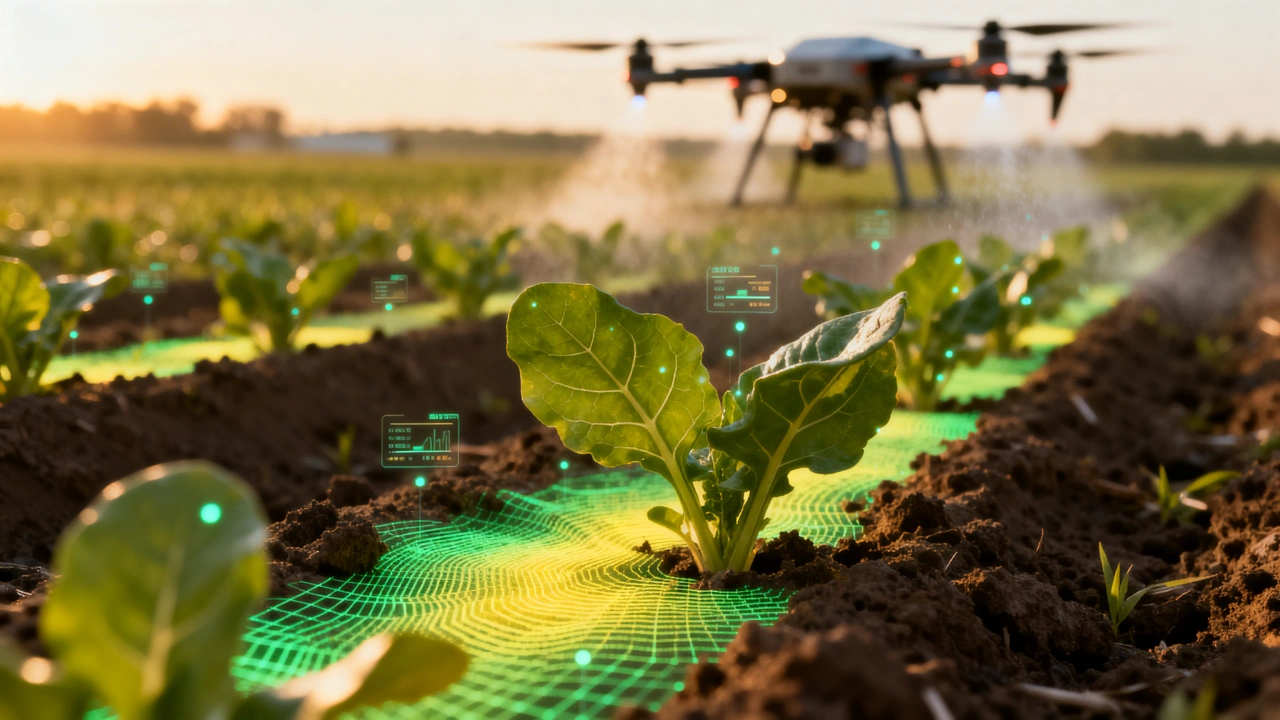
Arable farming used to be managed field by field, on averages and best guesses. With Edge AI, the unit of decision can now shift to the individual plant. On-board vision processors are able to assess crop health, spot fungal disease and judge ripeness on the spot, turning a single drone or sprayer pass into thousands of plant-by-plant calls.
A model that tells crop from weed lets a sprayer hit only the weeds; one trained on leaf images can identify a plant disease with over 96% accuracy, flagging an outbreak before it spreads.
The payoff is precise micro-treatment. Water, fertilizer and pesticide are applied exactly where each plant needs them and nowhere else, protecting yield while cutting inputs and costs.
This is throughput-hungry work: multiple camera streams, processed in real time, on a moving machine. Our SMARC modules built on Qualcomm’s Dragonwing QCS6490 are made for it. Qualcomm’s edge processors deliver high performance at relatively low power draw and low heat, which is what lets more powerful AI move out of the data center and into demanding industrial settings.
For full autonomous navigation, the same job scales up to higher-performance x86 COM Express modules – serious AI acceleration in the compact, rugged footprint a tractor or field robot demands.
Boosting cattle welfare and productivity
Livestock runs to a different rhythm: continuous, individual monitoring of every animal. Cameras can spot lameness in dairy cattle in real time from a single side-view camera, catching trouble days before a stockperson would. Neckband sensors classify behaviour such as standing, eating or walking at 99% accuracy, with the model quantized to run on the edge at 94%, spotting illness in its earliest, subtlest signs. Thermal cameras even trigger barn cooling when animals start to overheat. The benefit is healthier, more productive animals. You can catch problems early, experience fewer losses, better weight gain and higher milk yields.
Some of this is light enough to run on the animal itself. Take that virtual fence – the collar reads its own GPS position, decides on the spot whether the herd is straying, and nudges it back with an audio cue or vibration. No posts in the ground needed, no farm hands or cell signal required.
The heavier thinking, such as vision and herd-wide aggregation, runs on a barn-side module instead. And both work around the clock, often on battery, so efficiency beats raw horsepower. Something like our NXP i.MX 8M Plus-based module, with its integrated AI accelerator and low power draw, is a great fit: enough intelligence to run the models while sipping its power budget all day.
Facing the elements
Whether it’s crops or cattle, some of the demands on embedded compute design are similar. Out in the elements, you’ll need rugged hardware that shrugs off dust, vibration, heat and glare. You’ll need local AI that doesn’t depend on a connection, and a long, dependable supply life for the machines and devices so they stay in service for years.
We’re already working with OEMs to build exciting vision-based systems for object recognition, crop monitoring and even automatic harvesting. We also build the rugged systems around the compute – including sunlight-readable HMI terminals in tough aluminium housings, for use in everything from the tractor cab to the dairy, plus much more.
Building a smart agriculture product? Talk to our experts – we’ll help you get to market faster.