
Designing for Vision AI at the Edge: What to Consider
Vision AI is increasingly being deployed in the field to improve efficiency and reduce costs. It’s helping autonomous robots to self-navigate warehouses, analyzing camera feeds on tractor arms to spot-treat crops, and enabling robotic arms to use real-time visual recognition to pick and place parts on assembly lines. And these are just a few of the brilliant use cases out there.
But these game-changing capabilities come with heavy demands on the edge and it’s important to fully grasp the details before costly design errors are made. Let’s break them down.
Camera inputs and sensor fusion
Many Vision AI applications need more than a single viewpoint. In robotics, a system might use multiple camera feeds simultaneously, combining visual data with inputs from lidar and IMU sensors to build a complete picture of its environment.
This kind of multi-sensor fusion is what allows autonomous vehicles to map their surroundings, avoid obstacles, and figure out exactly where they are in 3D space using techniques like visual simultaneous localization and mapping (VSLAM). In agriculture, this is already enabling smaller autonomous tractors that compact the soil less and access spaces that full-sized vehicles can’t reach.
But what this means for your design is that the processor needs dedicated image signal processing (ISP) hardware capable of handling multiple concurrent MIPI CSI camera streams without bottlenecks.
When evaluating a platform, check how many camera inputs are available, and whether they can operate concurrently rather than sequentially.
Low-latency, local processing
In many Vision AI scenarios, decisions need to happen in milliseconds. A robotic arm on a production line needs real-time visual recognition to identify, track, and manipulate objects. An autonomous vehicle navigating a warehouse or field cannot afford to wait for a round trip to the cloud.
Running inference locally on the device itself removes that dependency entirely. It also solves a practical problem: many deployment environments simply do not have reliable connectivity. Agricultural machinery working in remote fields, robots spread across a large factory floor, and medical devices handling sensitive patient data all benefit from processing that stays on the device.
Local inference means lower latency, stronger data privacy, and a system that keeps working even when the network isn’t.
Look for a system-on-chip (SoC) that combines a dedicated neural processing unit (NPU) for efficient inference, a capable GPU and video processing unit (VPU) for multimedia workloads, and a CPU for application logic. A well-balanced architecture ensures no single component becomes a bottleneck, even when handling demanding tasks like image segmentation across multiple camera streams.
Power efficiency and rugged design
Edge devices often end up in places where power is limited, airflow is restricted, or the environment is physically harsh. Dust, extreme temperatures, vibration, and moisture are everyday realities on a factory floor or in an agricultural setting.
Fanless operation is a real advantage here. It eliminates a common mechanical failure point, reduces maintenance, and enables sealed enclosure designs. For battery-powered applications like autonomous vehicles, power efficiency is essential.
When evaluating a platform, look beyond the processor. Consider the full system power draw including cameras, connectivity, and storage. A design that delivers strong AI performance within a small power envelope will always be easier to deploy and maintain in demanding environments.
Are you designing a Vision AI application?
We can help. Tria’s experts have built industrial-grade Vision AI development kits powered by Qualcomm Dragonwing processors.
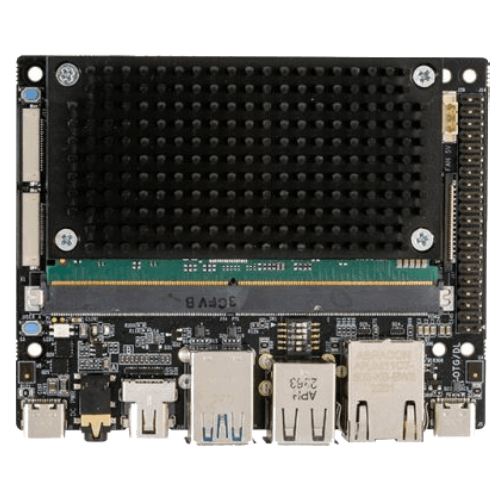
Our Vision AI-KIT 6490 is built on the flexible, scalable SMARC form factor so you can easily customize the baseboard to suit your application. It delivers 12 TOPS of AI acceleration with four concurrent camera inputs, fanless operation, and an industrial temperature range of -20°C to +65°C.
For heavier workloads, our Vision AI-KIT IQ9 steps up to 100 TOPS with support for up to 16 cameras and a real-time subsystem for low-latency control.
Both kits ship with a Linux BSP, example AI applications, and Tria’s lifecycle support. We can also help with ruggedized HMIs, empowering you to move quickly from concept to delivery.
Let’s get started. Get in touch with the Tria team.
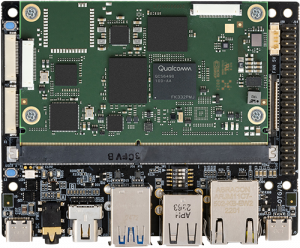
Vision AI-KIT 6490
Perfect for machine vision applications in robotics, Tria’s Vision AI-KIT 6490 features an energy-efficient, multi-camera, SMARC 2.1.1 compute module, based on the Qualcomm QCS6490 SOC platform.
Combining high image quality, low latency and powerful edge AI processing, the kit can be used as-is or as the starting point for a bigger, more custom system for your robotics design.