
The Brains Behind the Machine: What to Consider When Embedding Compute in Robotics
The robots and their demands
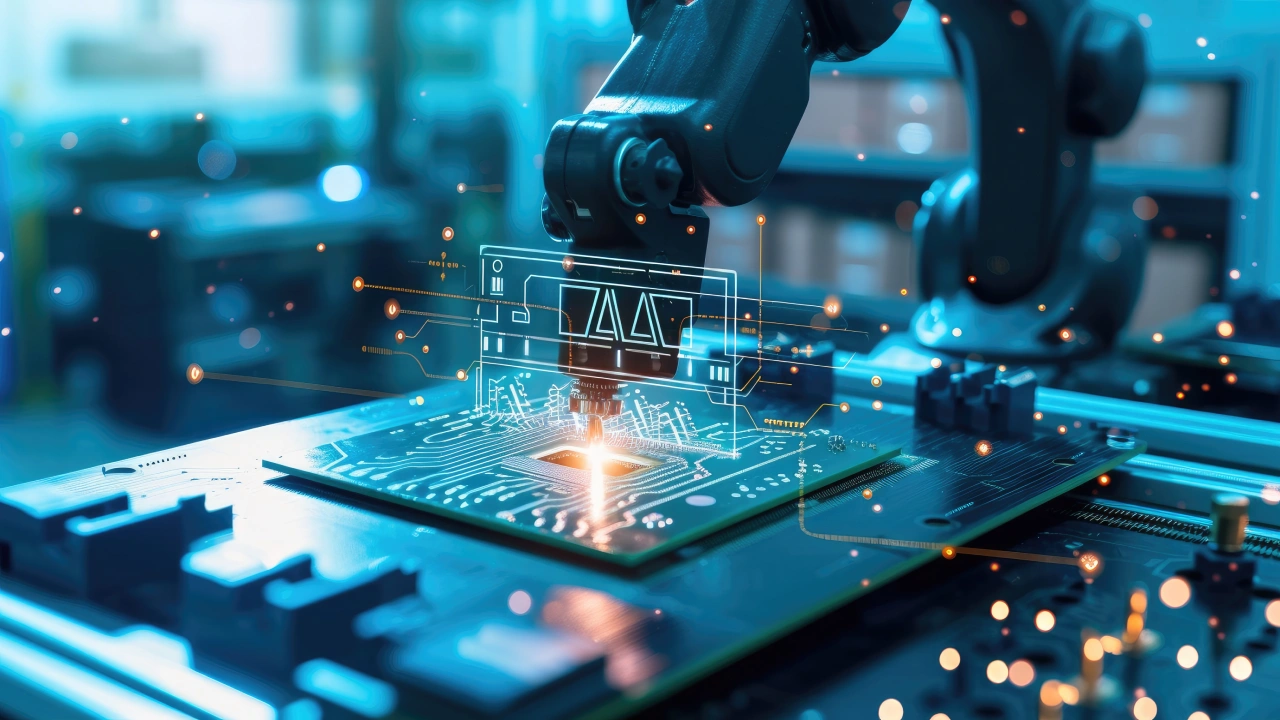
Industrial and production-line robots – the established workhorses of industry and production. Think articulated arms, SCARA (Selective Compliance Assembly Robot Arm) robots and delta pickers. They’re bolted down and often fenced off for safety. They trade flexibility for speed and repeatability, placing components or laying weld seams to sub-millimetre tolerances for years on end. Their compute must therefore prioritize deterministic motion control loops running at kilohertz rate. A missed cycle means a scrapped part. Increasingly, they are also carrying machine vision for inline inspection and guidance, adding serious image-processing workloads to a platform that still cannot miss a beat.
Collaborative robots – these share a workspace with us humans and so latency is a safety property. A cobot must fuse force and torque data continuously and react to unexpected contact within milliseconds. The compute platform therefore needs headroom for perception while guaranteeing that the safety-critical control path is never starved.
Mobile robots – the AMRs (autonomous mobile robots) and AGVs (automated guided vehicles) are now standard in logistics. They navigate environments that change by the second. So, simultaneous localization and mapping, sensor fusion across lidar, cameras and inertial units, and path planning all need to run onboard, and all run on a battery. Here, performance per watt is the defining constraint – every watt spent on compute is a watt not spent on payload or runtime.
Humanoid robots – the trickiest use case of all, but commercial units are increasingly entering pilot deployments at falling price points. A humanoid must balance, walk, manipulate and perceive simultaneously, coordinating dozens of joints while running AI inference for vision-and language-driven task models. It must achieve this within the power and thermal budget of a battery packed into a human-sized frame, with no room for a fan and no tolerance for a pause.
What you need to consider
Latency and determinism – the sensor-to-actuator path defines what a robot can physically execute. Modern manipulation tasks demand control rates of 20 Hz to over 100 Hz for AI-driven behaviours, and kilohertz rates for low-level joint control. Raw throughput matters less here than predictability – jitter in a control loop degrades precision faster than a slower but consistent processor. Heterogeneous architectures (application cores alongside real-time cores and dedicated AI accelerators) allow the hard real-time path to be isolated from heavier perception workloads. When evaluating a platform, ask how the time-critical path is protected, not just how fast the benchmark runs.
Sensors are getting faster, so compute must keep pace – lower-latency cameras, higher-resolution encoders and faster force-torque sensors can only deliver value if the platform is able to receive and act on their data on time. Multi-camera vision pipelines require capable image signal processors and neural accelerators close to the sensor. By running inference at the edge, inside the robot, the network round trip is removed entirely. Control and perception need to execute on-device, with the cloud reserved for training and fleet coordination.
Precision as a system property – higher precision demands tighter loops, enhanced sensor data and stable thermals. A processor throttling under load introduces variability that precision engineering cannot tolerate.
The software stack matters as much as the silicon – time-critical functions typically run on a real-time operating system or bare-metal firmware, where deadlines are guaranteed; embedded Linux handles vision, AI inference and networking alongside. A robot with excellent mechanics can still fail in the field through poor embedded implementation – blocking delays, timing drift or mishandled interrupts, so mature board support and firmware expertise matter as much as raw specifications.
Physical constraints shape the architecture – power, heat, size and placement all decide what is feasible. Sealed, fanless enclosures limit thermal dissipation; battery operation caps power draw; and compute is increasingly distributed, with small-form-factor modules embedded directly into limbs and joints, where fast local sensor response and fine motor control matter most.
Finally, think in decades, not product cycles – industrial robots stay in service for ten years or more. Long-term component availability, a scalable module roadmap, environmental ruggedization and regulatory compliance all matter as much as benchmarks figures. That means CE (Conformité Européenne) marking in Europe, UL (Underwriters Laboratories) certification in North America and now cyber-security rules such as the EU’s Cyber Resilience Act (CRA) and the Radio Equipment Delegated Act (RED DA).
Modularity: designing for the possibility of change
The strongest solution to these various demands is to use modular embedded hardware. Standards such as SMARC, OSM and COM Express separate the compute module from the carrier board, so the processor becomes a replaceable component rather than a fixed commitment. An OEM can subsequently offer one robot family at several performance tiers by fitting different modules to the same carrier, upgrade compute mid-lifecycle as AI workloads grow, and respond to component obsolescence without a full board re-spin. Modularity also reduces development time – a design proven on a development kit can move to production on the same module, leaving the carrier board, the part unique to the robot, as the only custom engineering required. For machines expected to evolve over a decade in service, that flexibility is the architecture.
Are you building the robots of the future?
We can help. The compute decisions made now around latency budgets, thermal strategy, module standards or upgrade paths, will shape a machine that may still be in service in 2040.
At Tria, we design and manufacture embedded compute modules, systems and development kits built for exactly these demands: from the Vision AI-KIT 6490, a SMARC-based multi-camera edge AI platform ready for machine vision in robotics, to OSM modules small enough to live inside a limb.
We work alongside robotics OEMs from design to delivery.
Let’s get started – get in touch with the Tria team.